


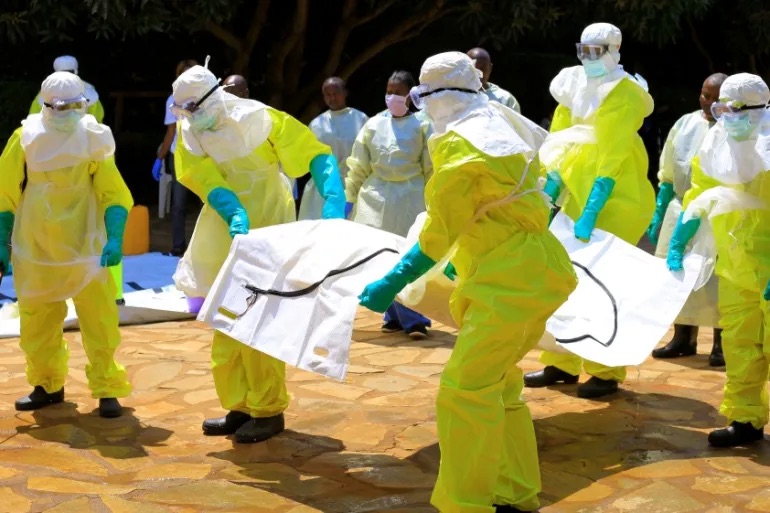
The UN Children’s Fund (UNICEF) says that more than 1,900 children have lost or been separated from one or both parents or caregivers to Ebola across eastern Democratic Republic of the Congo (DRC) since the outbreak was declared in May.
UNICEF said in a statement on Tuesday that Ebola had been robbing children of their loved ones, with some succumbing to the deadly disease themselves.
The update comes as regional neighbour Kenya confirmed its first case and death from the disease, believed to have come from DRC.
The UN agency said 1,581 children had been identified in Ituri and another 322 in North Kivu as of 28 September, noting that the actual figures are likely higher, as they reflect only locations where UNICEF collaborates with the Provincial Division of Social Affairs (DIVAS).
“For children, Ebola can set off a rapid chain of harm,” UNICEF Director of Emergency Operations Lucia Elmi said, following a visit to the epicentre of the outbreak in Bunia.
“Once a parent falls ill, a child could become exposed. That parent is then hospitalised or dies, and the child is left without the person they depend on, while fear of infection and stigma leaves relatives and neighbours afraid to step in.”
An additional 214 children living and working on the streets in Bunia have been identified as needing protection.
Without a caregiver, these children are at risk of infection, less likely to be reached by contact tracing or brought to care if they fall ill, and they face heightened risks of exploitation and violence.
Children are also disproportionately affected by the outbreak. As of September 29, at least 2,076 children had been confirmed with Ebola, and at least 1,162 had died, according to UNICEF analysis of Ministry of Health data where age was recorded.
Children make up over one in four confirmed cases but roughly one in three deaths.
The youngest face the gravest danger, as seven in ten children under five with confirmed Ebola have died—up from six in ten just weeks ago.
“In Bunia, I met Lina*, a seven-month-old baby who survived Ebola after losing her mother to the disease,” Ms Elmi said.
At the national level, more than 8,224 cases and 3,982 deaths in total have been confirmed across seven provinces as of September 29. Ituri remains the province with the most cases, while cases persist in North Kivu.
Even before this outbreak, children in eastern DRC were living through one of the world’s most protracted humanitarian crises.
The virus is spreading through provinces that host around 4.4 million internally displaced people, where conflict, displacement, and mistrust make early detection harder.
UNICEF supports 12 nurseries near Ebola treatment centres in Ituri, North Kivu, and South Kivu.
UNICEF-supported services have reached 90,600 people through psychoeducation sessions, while over 15,900 family members have received psychosocial support at home.
Meanwhile, the World Health Organisation (WHO) is monitoring the situation in Kenya, which on Tuesday confirmed its first case and fatality, according to media reports.
Spokesman Christian Lindmeier said the case was “likely imported from DR Congo”, but more information was not available.
He said colleagues on the ground are working with the Kenyan authorities to get more details.