


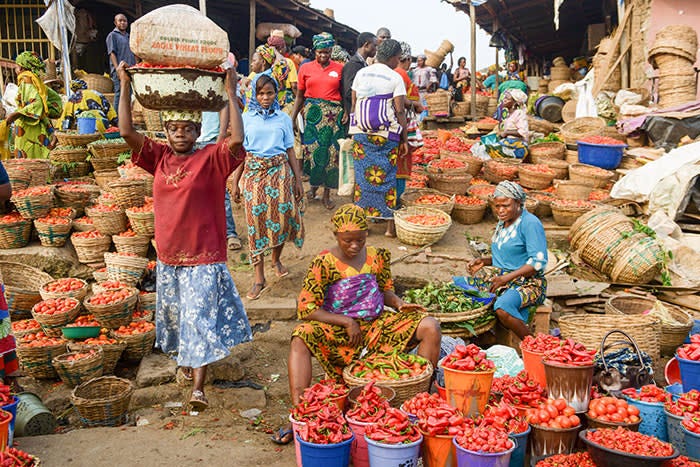
The National Bureau of Statistics (NBS) says Nigeria’s headline inflation rate dropped to 14.63 per cent in September.
The NBS’ Consumer Price Index (CPI) and Inflation Report for September, released on Thursday, said headline inflation fell to 14.63 per cent from 15.39 per cent in August, a reported decline of 0.65 per cent.
On a month-on-month basis, headline inflation stood at 0.06 per cent in September, down from 0.71 per cent in August 2026.
“This means that in September, the rate of increase in the average price level was lower than the rate of increase in the average price level in August,” it said.
Year-on-year headline inflation stood at 14.63 per cent in September, compared with 20.98 per cent in September 2025.
The three largest contributors to year-on-year headline inflation were food and non-alcoholic beverages at 5.85 per cent, restaurants and accommodation services at 1.89 per cent, and transport at 1.56 per cent.
The least contributors were recreation, sports and culture at 0.05 per cent; alcoholic beverages, tobacco and narcotics at 0.05 per cent; and insurance and financial services at 0.07 per cent.
“The CPI increased to 146.38 in September and reflected a 0.08-point increase from the 146.30 recorded in August,” it said.
Food inflation stood at 19.59 per cent year-on-year in September, compared with 20.16 per cent in September 2025. On a month-on-month basis, food inflation was -1.55 per cent, down from 1.02 per cent in August.
The NBS attributed the rise in food inflation to changes in the average prices of items including cornflour, maize (corn), white flour, local rice, eggs, onions, palm oil, green beans, Irish potatoes, fresh tomatoes and plantain, among others.
Core inflation, which excludes the prices of volatile agricultural produce and energy, stood at 12.95 per cent year-on-year in September.
“This shows a decline of 9.16 per cent when compared to the 22.11 per cent recorded in September 2025.
“On a month-on-month basis, the core inflation rate was 1.11 per cent in September, which increased by 1.17 per cent compared to the -0.06 per cent recorded in August,” it said.
Urban inflation stood at 15.64 per cent year-on-year in September.
“On a month-on-month basis, the urban inflation rate was 0.53 per cent, which increased by 0.25 per cent compared to August at 2.28 per cent.”
Rural inflation stood at 12.46 per cent year-on-year in September. On a month-on-month basis, it was -0.89 per cent, down 2.68 per cent from 1.79 per cent in August.
The report showed that Imo recorded the highest year-on-year all-items index inflation rate in September at 30.04 per cent, followed by Enugu at 22.38 per cent and Niger at 22.05 per cent.
Taraba recorded the lowest year-on-year headline inflation rate at 1.78 per cent, followed by Bauchi at 2.89 per cent and Adamawa at 3.66 per cent.
On a month-on-month basis, inflation was highest in Imo at 8.64 per cent, followed by Kaduna at 4.46 per cent and Sokoto at 3.01 per cent.
“Adamawa at -6.10 per cent, followed by Bauchi at -5.31 per cent and Kano at -4.49 per cent recorded a decline in month-on-month inflation,” it said.
Year-on-year food inflation was highest in Lagos at 34.40 per cent, followed by Imo at 33.79 per cent and Ondo at 31.49 per cent.
Taraba recorded the lowest food inflation rate at -7.47 per cent, followed by Yobe at -0.37 per cent and Borno at 2.18 per cent.
On a month-on-month basis, food inflation rose most in Imo at 5.15 per cent, followed by Ondo at 4.46 per cent and Oyo at 3.82 per cent.
“Adamawa, at -13.84 per cent, followed by Kano at -11.01 per cent and Bauchi at -10.21 per cent, recorded a decline in food inflation on a month-on-month basis.”