


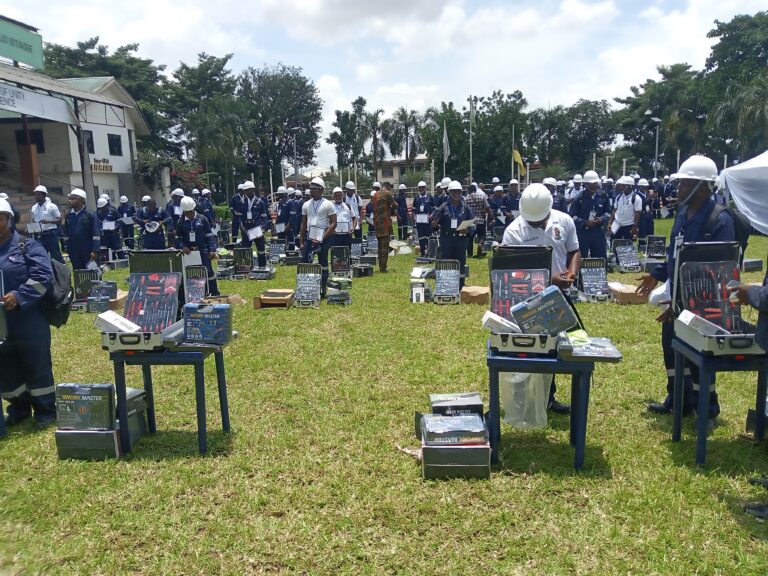
The National Agency for Science and Engineering Infrastructure (NASENI) says 100 Onitsha youths have benefited from its skill acquisition programme in modern methods of electrical installation and maintenance.
The agency’s chief executive officer, Khalil Halilu, said this on Friday during the closing ceremony of a five-day training for the 100 people in Onitsha.
The participants were also given complete starter packs, consisting of electrical tools and equipment.
Halilu said the programme was being executed across the country under the NASENI Sustainable Empowerment Programme.
“This programme is founded on a simple but important conviction of science, technology and innovation, which must produce tangible improvements in the everyday life of Nigerians.
“Today’s intervention is built around three core empowerment items: the NASENI solar home system, NASENI clean cookstoves and NASENI support pack,” Halilu said.
He also said the NASENI solar home system would provide beneficiaries with access to reliable renewable energy for lighting, charging essential devices and supporting household activities.
According to him, beyond improving daily living, it can help small businesses operate for longer hours while reducing dependence on expensive and unreliable sources of energy.
The agency’s boss explained that the NASENI clean cookstoves provide safer, cleaner and more efficient means of cooking.
“They are designed to reduce fuel consumption, lower household expenses and minimise exposure to harmful smoke,” he said.
He said the NASENI support pack was meant to provide additional relief and strengthen the capacity of beneficiaries to meet immediate household needs.
The Commissioner for Youth and Sports Development, Patrick Aghamba, commended the federal government for its policies and programmes, especially the empowerment schemes of the Renewed Hope Agenda.
Aghamba said the training programme was synonymous with the state government’s “One Youth, Two Skills” programme that had helped to empower over 10,000 beneficiaries.
The coordinator of Onitsha Advancement Foundation, Rita Melifonwu, said the programme was advertised to get 100 interested youths, and interviews were conducted to reduce the over 100 applicants to 100.
Melifonwu explained that 56 of the participants were electricians, adding that 27 were students studying electrical engineering in various tertiary institutions.
She said the number also included five women, who are indigenes, while 17 are non-indigenes of Onitsha.
Some participants thanked the federal government for the initiative and promised to properly deploy the tools and equipment to their utmost benefit.