


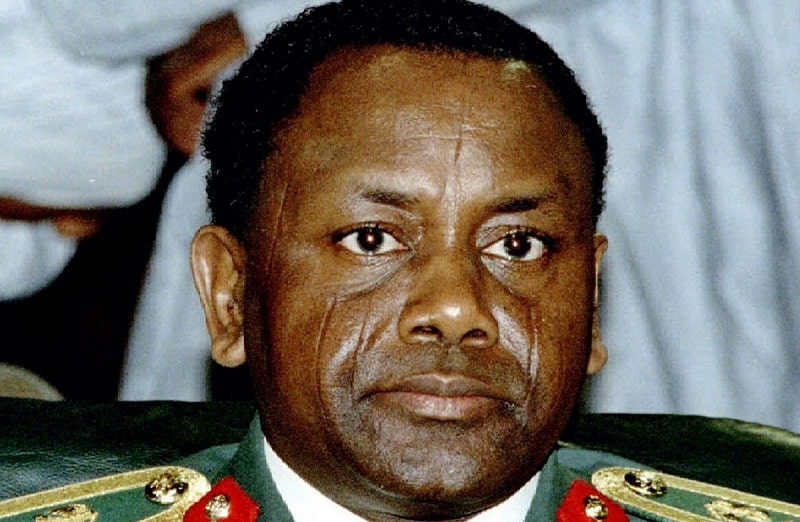
Stephen Ogunpitan, a professor of English at Lagos State University (LASU), has recounted how former military Head of State Sani Abacha allegedly ordered his arrest, dead or alive, in September 1995 over a book review.
Ogunpitan disclosed this on Tuesday while delivering the university’s 130th inaugural lecture at the Buba Marwa Auditorium, Main Campus, Ojo, Lagos.
The lecture was titled “Narrative as Cartography: Enlarging Human Vision Through Fiction”.
He said the incident occurred during a period of political tension and suspicion under the Abacha administration, when some visitors arrived at the university with instructions to find and capture him.
“The order for that search had come from none other than the then Military Head of State, General Sani Abacha himself, with instructions that I be captured dead or alive,” he said.
Ogunpitan said a book review he published in The Guardian attracted Abacha’s attention and reportedly prompted the search for him on the university campus.
He described the incident as an unusual chapter in his life, saying it deepened his understanding of the relationship between power, fear and narrative.
He said a Fulbright Fellowship to Cornell University in the United States eventually took him beyond the reach of those searching for him.
Reflecting on the experience, Ogunpitan said it demonstrated the power of written words to challenge authority and influence public discourse.
“And so, I learned firsthand that in the battle between the sword and the pen, the pen not only wins, it can make a dictator lose sleep over a fabulous innocuous little novella,” he said.
He added humorously that writers did not need an army to unsettle dictators, but only a pen and a deadline.
“If you want to scare a dictator, you don’t need an army, just give a literature professor a pen and a deadline,” he said.
The professor said the experience taught him that a single book review could have consequences beyond its immediate literary purpose.
He also cited Nobel laureate Wole Soyinka, who said: “Books and all forms of writing are terror to those who wish to suppress the truth.”
Turning to the role of literature, Ogunpitan said narratives, particularly fiction, remained important tools for understanding human experiences, societal challenges and complex human relationships.
Using the biblical story of Cain and Abel, he explained how narratives could illuminate issues such as jealousy, betrayal, sibling rivalry, domestic violence, guilt and punishment.
He said the story also established an archetypal pattern of crime-and-punishment narratives through the presentation of crime, motive, investigation, trial and punishment.
The professor described science fiction as a powerful tool for anticipating future developments and expanding human imagination.
He said the genre had influenced advances in artificial intelligence, physics, computer science, communications, military strategy, bioengineering and space exploration, including the development of technologies such as mobile phones.
According to him, science fiction provides a conceptual laboratory where writers explore possibilities before they become scientifically or technologically achievable.
He described writers as explorers who use imagination to construct possible futures and help humanity navigate uncertainties.
Ogunpitan also highlighted his contribution to literary studies through the development of a theory of the classics of war fiction.
He said the framework examined common literary, philosophical and humanistic concerns in fictional representations of wars across different historical and cultural settings.
According to him, it brought American and Nigerian civil war narratives into comparative conversation, challenging the dominance of Western literary traditions in theoretical scholarship and recognising African literature as a source of globally relevant literary theories.
He said the approach also supported the decolonisation of comparative literature by affirming the intellectual authority of African literary traditions.
The professor urged universities to reposition literature as an essential tool for moral, civic and intellectual development.
He recommended stronger integration of literature with science, technology, psychology and medicine to promote interdisciplinary research and address societal challenges.
He also urged educators to encourage reading as a lifelong habit rather than merely an examination requirement.
Ogunpitan described teaching English without adequate literary content as ineffective, likening it to “pushing a car to start without an engine”.
He called on policymakers and national development planners to support literary projects, translations and archives to promote national consciousness and social cohesion.
He said fiction remained indispensable to developing empathy, ethical reasoning, cultural awareness and imaginative problem-solving.
He concluded that narratives remained among humanity’s greatest tools for understanding its origins, identities and possible futures.