


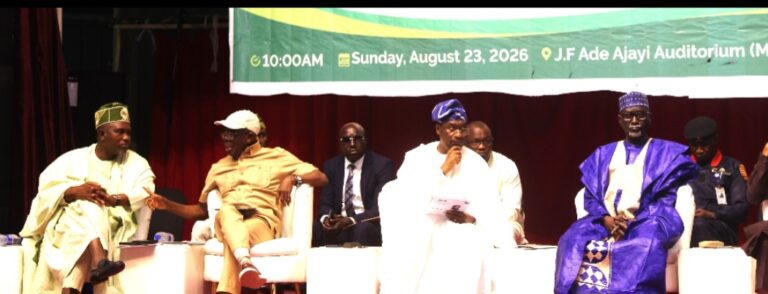
The Lagos State Deputy Governor, Dr Obafemi Hamzat, on Sunday urged Nigerians to deliberately build a stronger national identity that transcended ethnic, religious and cultural differences.
Hamzat made the call at the 7th National Discourse, held at the University of Lagos, Akoka, Lagos.
The event had as the theme, “Interrogating Nigeria’s Democracy in the Context of Multiple Diversity”.
He said Nigeria’s political system must evolve mechanisms that accommodated its diverse identities without allowing them to undermine national unity.
According to him, ethnic and religious identities remain deeply rooted in the country’s social and political life.
‘’The challenge is not to eliminate them, but to prevent their misuse as tools of division.
“The question that sociologists have not told us is how we marry our culture and democracy, without losing our identity and putting it into our democratic setting.
“As Nigerians, we must learn to accommodate our differences, while we are also promoting a common national identity.
“The experience of other multi-ethnic societies showed the dangers of allowing identity and class differences to fuel conflict among us,” Hamzat said.
The deputy governor also advocated greater religious tolerance and adherence to the core teachings of Islam and Christianity, urging citizens to respect one another’s faiths.
He emphasised the role of culture in strengthening unity and urged Nigerians to preserve their cultural heritage, while fostering a shared national identity.
In his address, Sen. Adams Oshiomhole called on Nigerians to shun ethnic and religious divisions and build a nation where leadership was driven by competence, ideas and values.
He warned against the use of ethnicity and religion for political mobilisation or as a shield against accountability.
“Our ethnicity should not be a source of challenge. It should give us all of the things that we need to be the greatest country, not only in Africa but in the world.
“This ethnicity is very dysfunctional. Nobody should be rewarded or punished on account of an accident of birth.
“Ethnicity has very little or no role to play, except to function as a tool in the hands of a segment of the political elite who substitute ethnicity in place of ideas,” he said.
Oshiomole added that Nigeria’s diversity should be seen as an asset capable of driving development, stressing that fairness and equal treatment of citizens would enhance national growth.
He further noted that Nigeria’s vast human and natural resources could position it among the greatest nations globally if properly harnessed.
In his remarks, former Governor of Kano State, Ibrahim Shekarau, called for deeper religious tolerance and understanding among Nigerians.
According to him, there is no justification for religious conflict, as all citizens, regardless of faith, were creations of Allah.
Shekarau urged Nigerians to deepen their understanding of religious teachings, noting that all faiths promote love, justice, kindness and respect.
He said, “If Nigerians genuinely practise the teachings of their religions, the country will be a better place.”
The former governor warned against allowing religious differences to fuel division.
He also identified consultation, fairness and respect for divergent views as key principles of good governance, cautioning leaders against pursuing personal interests at the expense of the people.
Earlier, a cleric and the National Leader of a group, The Companion, Noreem Jimoh, said the discourse was convened to examine challenges confronting Nigeria’s democracy within its diverse setting.
The Companion is an association of Muslim men in business and the professions in Nigeria.
Jimoh urged Nigerians to critically assess the country’s democratic journey and seek practical solutions to make it more effective, particularly in managing ethnic, religious, cultural and regional differences.
He described Nigeria’s diversity as both strength and challenge, stressing that its effective management remained crucial to democratic success.
Also speaking, former Director-General of the Administrative Staff College of Nigeria, Mr Liasu Jinadu, identified ethnicity as a major factor shaping Nigeria’s political development since colonial times.
Jinadu said political elites had exploited ethnic identities to build patron-client relationships and secure support, thereby weakening institutions and undermining governance.
According to him, ethnicity has often been used to mask political impunity, corruption and abuse of power.
He called for a political system that prioritised citizenship, human security and development above ethnic considerations, in line with the 1999 Constitution.
Jinadu also stressed the need to empower citizens to participate meaningfully in governance.
He said, ‘’Lack of economic opportunities, transparency and security limits their ability to exercise their rights.’’