


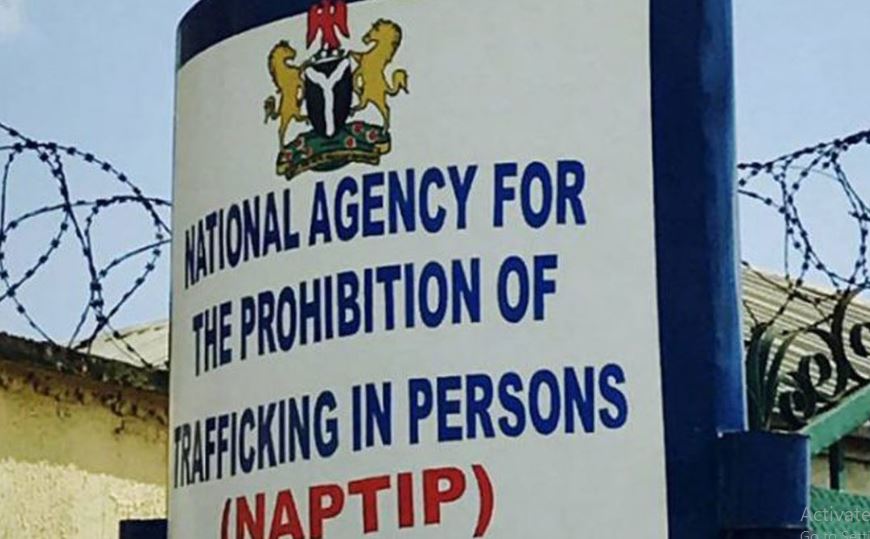
The National Agency for the Prohibition of Trafficking in Persons (NAPTIP) says it has rescued and supported 28,762 victims of human trafficking and secured 857 convictions since its establishment.
The agency’s Director-General, Binta Adamu-Bello, disclosed this on Tuesday in Abuja at the opening of the 29th National Stakeholders’ Consultative Forum on Human Trafficking in Nigeria.
Adamu-Bello said NAPTIP recorded 1,508 cases of human trafficking and related offences between August 2025 and November 2026, leading to 1,434 arrests.
She said 52 per cent of those arrested were males and 48 per cent females, while the agency received and rehabilitated 2,700 victims during the period.
According to her, children accounted for 48 per cent of the victims, while adults made up 52 per cent. Females constituted 72 per cent of the victims, compared with 28 per cent males.
She said the agency initiated 65 cases involving 85 accused persons in court and secured 74 convictions involving 97 offenders during the period.
Adamu-Bello explained that the convictions included cases instituted before the previous stakeholders’ forum in 2025.
She said the figures reflected NAPTIP’s efforts to strengthen investigations, prosecution, victim protection, rehabilitation and collaboration with relevant institutions and international partners.
The director-general said the agency had intensified intelligence gathering and surveillance to identify and disrupt trafficking networks operating both offline and online, particularly those involved in deceptive online recruitment and cyber-enabled trafficking.
She added that NAPTIP had strengthened support for survivors through psychosocial counselling, vocational training, family tracing and reunification, legal assistance and economic empowerment.
Adamu-Bello also said NAPTIP had established a new state command in Kogi, leaving Delta as the only state without the agency’s operational presence.
She appealed to the Delta Government to facilitate the establishment of a command in Asaba, citing operational costs and delays in responding to emergencies under the existing arrangement with the Benin Zonal Command.
She also disclosed that Abia had established a State Task Force on Human Trafficking, bringing the number of states with such structures to 25.
The director-general said the National Human Trafficking Dashboard continued to support the monitoring of the National Action Plan on Human Trafficking (2022–2026), improve reporting and strengthen accountability among implementing institutions.
She said the 29th forum was particularly significant because the current National Action Plan would end in December 2026, requiring stakeholders to assess its implementation and develop a new framework for 2027–2031.
In his address, the Attorney-General of the Federation and Minister of Justice, Lateef Fagbemi, urged state governments to take greater responsibility for combating human trafficking by strengthening state task forces and providing adequate funding for anti-trafficking programmes.
Fagbemi, represented by Haliru Kabiru, Acting Director of the Citizenship Rights Department, Federal Ministry of Justice, said the fight against trafficking should not be left to the Federal Government alone.
He said no state was immune to human trafficking, adding that young Nigerians continued to fall victim to trafficking networks exploiting their vulnerabilities and aspirations.
The minister urged Ministries, Departments and Agencies (MDAs) to fulfil their mandates, share relevant information and submit timely and accurate reports to strengthen national coordination.
He also called for stronger collaboration with technology companies, telecommunications operators, financial institutions and digital service providers to prevent traffickers from exploiting their platforms.
Fagbemi said the next National Action Plan should contain measurable targets, clearly defined institutional responsibilities, adequate funding and effective monitoring and evaluation mechanisms.
He identified four expected outcomes of the forum: an evidence-based assessment of the outgoing plan, identification of implementation gaps, practical recommendations for improved coordination and agreement on priorities for the 2027–2031 framework.
Also speaking, the UN Office on Drugs and Crime (UNODC) Country Representative, Cheikh Touré, represented by the organisation’s Nigeria Operations Manager, Williams Shiyin-Wu, called for improved data management and stronger coordination between national and state institutions.
Touré said reported trafficking cases represented only a fraction of the actual problem, underscoring the need for proactive identification, research and community engagement.
He said UNODC would continue supporting Nigeria in strengthening institutional cooperation, harmonising data systems and building the technical capacity of stakeholders involved in investigating and prosecuting trafficking offences.
Similarly, the International Organisation for Migration (IOM) Chief of Mission, Dimanche Sharon, represented by its Protection Officer, Chibalami Katongo, said the organisation had supported the safe and dignified return of more than 8,200 trafficking victims since 2017, in collaboration with NAPTIP.
Sharon said 88 per cent of the returnees were women and girls, while approximately 5,500 survivors had benefited from economic, social and psychosocial reintegration assistance, including skills development, healthcare and income-generating opportunities.
She stressed that survivors required sustained support beyond their return, adding that effective reintegration depended on collaboration among government institutions, civil society organisations, families and communities.
The IOM chief reaffirmed the organisation’s commitment to supporting NAPTIP, state task forces and other stakeholders in reviewing the outgoing National Action Plan and developing the 2027–2031 framework.
The forum brought together representatives of federal and state governments, development partners, civil society organisations and other stakeholders to review Nigeria’s anti-trafficking efforts and strengthen the national response.