


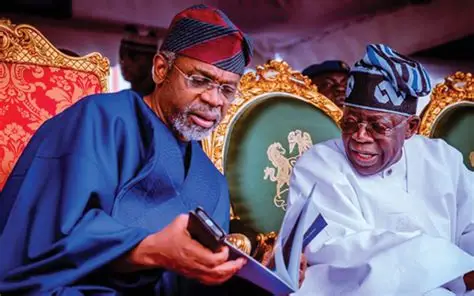
Chief of Staff to President Bola Tinubu, Femi Gbajabiamila, says the president has governed as a statesman rather than a politician since assuming office, choosing to confront the country’s economic challenges despite the immediate political costs.
Gbajabiamila said this on Tuesday in Abuja while defending the administration’s economic policies at the unveiling of its 2027–2031 electoral roadmap, titled “From Reforms to Prosperity Agenda.”
He said the administration’s overarching goal was to build an economy where honest labour could guarantee a decent livelihood.
Gbajabiamila distinguished between political leadership driven by short-term electoral considerations and statesmanship anchored on long-term national interests.
He said while politicians were often preoccupied with the next election, genuine leaders focused on the next generation and the interests of citizens.
“If he came in as a politician and decided to govern as a politician, he would have continued on the cruise, on the path that we were taking.
“But instead, knowing full well the immediate consequences, he decided he would govern as a leader,” Gbajabiamila said.
He acknowledged that the removal of petrol subsidy and the unification of the foreign exchange system had placed significant pressure on households.
“Now, those decisions have placed real pressure on households. We must speak honestly about that experience because the people living through it deserve to be heard. And nobody should have to pretend that life is easy at the moment,” he said.
However, he argued that reversing the reforms would have undermined the country’s long-term economic viability.
He said the ultimate test of the reforms was whether their structural gains would translate into tangible improvements in Nigerians’ daily lives.
The former Speaker of the House of Representatives described the administration’s new roadmap as bold and audacious, linking it to the president’s political philosophy.
He also described the policy document as a binding legal and moral agreement between the government and citizens.
“At the heart of this manifesto is my abiding conviction that every Nigerian should be able to share. Your country should give your best efforts a fair chance.
“A manifesto, in its strictest sense, is simply a contract between the people and the leader,” he said.
Gbajabiamila said the administration aimed to create opportunities for young Nigerians to pursue their ambitions and ensure public service delivery was not dependent on political patronage.
He said several structural interventions were already being implemented, including human capital development and social support programmes such as N-Power and student loans to help with tuition and living expenses.
He also cited the administration’s tax reforms, which he said were designed to reduce the tax burden on low-income earners and eligible small businesses.
On electricity, he said the Electricity Act had empowered states to establish and regulate their own electricity markets to attract investment and expand access.
Gbajabiamila said citizens should have clear mechanisms to monitor government performance and hold public officials accountable.
He urged All Progressives Congress (APC) members and stakeholders to defend the administration’s record and engage directly with communities.
“The party asking to continue in government must be prepared to answer the people whose mandate it seeks.
“We must earn support through the quality of work, through the quality of our case and the seriousness of our conduct,” he said.
He said the 2027 general election would present Nigerians with a choice between sustaining the administration’s reform agenda and returning to what he described as short-term politics.